
Senator shatters the silence around vaginal prolapse
By Rob Clancy, staff writer. Reviewed by Associate Professor Shayanti Mukherjee

A lone Senator from Tasmania has achieved in one speech what Hudson Institute of Medical Research has spent years attempting: to get the words vagina and prolapse in the nation’s media.
Key Points
- Senator Lambie’s speech in Parliament about her experience of vaginal prolapse has brought this public health issue into the open
- Hudson Institute is a leader in researching treatments and cures for this condition
- Sen Lambie’s Vagina Collection is raising awareness and funds for POP and related research.
When Senator Jacqui Lambie stood up in federal Parliament to speak about her personal experience of Pelvic Organ Prolapse (POP) and its impact on her life, millions of women felt her pain.
POP is a condition affecting 1-in-4 women and up to 50 per cent of women who have had children.
It’s also a condition that Hudson Institute researchers have been working for years to prevent and cure.
And the research shows huge promise, combining the latest in stem cell technology with groundbreaking bioengineering to develop treatments for this debilitating condition that is so seldom spoken about.
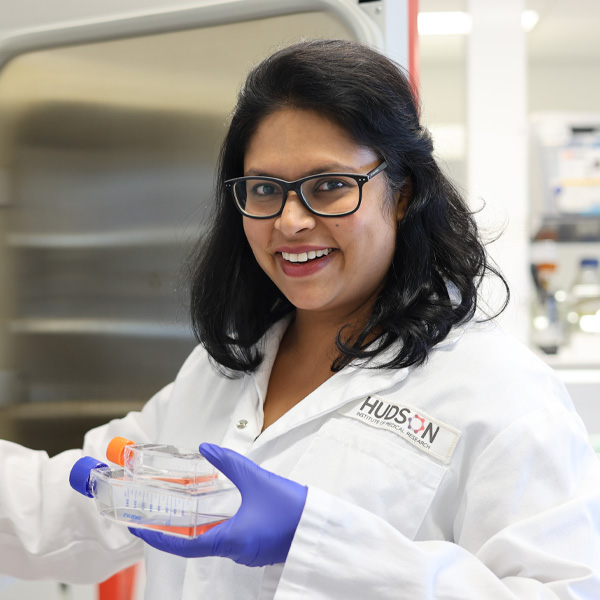
“Pelvic organ prolapse (POP) is a debilitating condition that affects many women, soon after or many years after vaginal birth. There is currently no reliable cure for POP.
My research involves developing new generation of surgical solutions including bioengineering with resorbable materials, surface chemistry and the application of biologics to develop effective treatments.”
– Associate Professor Shayanti Mukherjee
Perhaps the only thing more difficult than securing funding for this research is convincing Australia’s media to write about it, but thanks to Sen. Lambie, that has now changed.
Her passion struck a chord and she is now making the most of this interest, producing a range of merchandise to highlight this major public health issue, and raising funds for Hudson Institute’s research at the same time.
The vagina collection aims to demystify women’s health, attracting more focus and more money, to accelerate the research process.
After her speech, Sen. Lambie’s office received some comments about how ‘vulgar’ it was to use the word vagina.
But in her words: “Well that’s just rubbish, half the population has one – and if their insides aren’t working, it’s a big problem!”
Jacqui wants to break this stigma for good. She says being offended by the word vagina just makes it harder for women to seek help.

About POP
- POP is essentially a hernia through which organs protrude because supporting tissue is weak.
- POP develops when tissues, pelvic floor muscles and ligaments that support the pelvic organs (bladder, uterus and bowel) become damaged, usually in childbirth, causing organs to shift or ‘drop’ into or outside the vagina.
- This can lead to debilitating symptoms, including poor bladder or bowel control and pain during sex.
- The condition can be exacerbated by age, ethnicity, multiple births, obesity and family genetics.
- One in five women require surgery – and often multiple surgeries.
- There is no reliable cure for pelvic organ prolapse.
This research was supported by | The Vagina Collective - Senator Jacqui Lambie

In this article

About Hudson Institute
Hudson Institute’ s research programs deliver in three areas of medical need – inflammation, cancer, women’s and newborn health. More

Hudson News
Get the inside view on discoveries and patient stories
“Thank you Hudson Institute researchers. Your work brings such hope to all women with ovarian cancer knowing that potentially women in the future won't have to go through what we have!”
