
A decade of treating Primary Aldosteronism at Monash Medical Centre
By Rob Clancy, staff writer. Reviewed by Professor Jun Yang

For the past 10 years, a dedicated team at Monash Medical Centre has been quietly transforming the lives of people with primary aldosteronism (PA) – the most common hormonal cause of high blood pressure.
What began as a simple clinic has grown into one of Australia’s leading endocrine hypertension services, giving more patients access to specialised care for a condition that often goes undiagnosed for years.
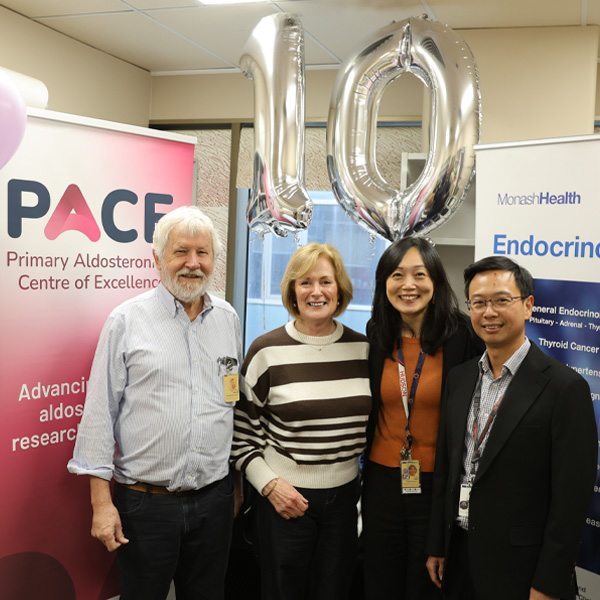
The clinic was created in 2016 to address a critical gap in the detection of endocrine (hormone-related) causes of hypertension – conditions that are frequently under-recognised but often treatable. Over the past decade, it has grown from one clinical session per fortnight to 14 sessions – and it is recognised as a leading multidisciplinary service, combining clinical care with research and innovation. For many patients, this means receiving an explanation for years of difficult-to-control blood pressure, and access to treatments that are tailored to the underlying cause of their condition.
“Many of our patients come to us after years of living with high blood pressure without knowing why,” Professor Jun Yang, Head of the Endocrine Hypertension Clinic and clinician-researcher at Hudson Institute, said. “One of the most rewarding aspects of our work is being able to offer treatments that can significantly improve their health and quality of life.”
Centres of endocrine hypertension excellence
Established under the aegis of the Endocrinology Unit of Monash Health and Hudson Institute of Medical Research by endocrine specialists Professor Jun Yang, Professor Peter Fuller and Dr Jimmy Shen, the clinic has run in parallel with their research at Hudson Institute, which has now grown into an NHMRC Centre of Research Excellence, PACE (Primary Aldosteronism Centre of Excellence).
Hypertension remains one of the leading risk factors for cardiovascular disease. Importantly, their research found that 10 – 20% of people with hypertension may have this underlying endocrine cause, primary aldosteronism. However, the condition is often missed in routine care, with barriers including limited healthcare provider awareness, access to diagnostics pathways, and variability in clinical management.
The clinic provides access to streamlined diagnostic services, including ambulatory blood pressure monitoring, dynamic testing such as saline suppression tests, and adrenal vein sampling. These capabilities enable precise diagnosis and personalised treatment, which in some cases can lead to a complete cure of the disease (and cure of hypertension).
Multidisciplinary approach is the key
A key strength of the service is its multidisciplinary approach, ensuring patients can access coordinated care from diagnosis through to treatment and long-term follow-up. Endocrinologists, nursing staff, chemical pathologists, interventional radiologists, and endocrine surgeons work collaboratively to deliver comprehensive, patient-centred care.
The clinic also maintains strong links with research programs led by the Endocrine Hypertension Group at Hudson Institute, with active participation in cohort studies and clinical trials. Collectively, the group contributes to international efforts to improve the diagnosis and management of endocrine hypertension.
As the clinic celebrates this 10-year milestone, it continues to focus on expanding awareness, improving early detection, and advancing research so that more people can access timely diagnoses, avoid preventable complications and benefit from effective treatment of the root cause of their hypertension.
The Monash Health Endocrine Hypertension Clinic at a glance
- 1650 patients to date have accessed its services – of these, 557 have been diagnosed with PA and many more are currently under investigation.
- Patients are being referred to the clinic earlier, with the median time living with hypertension before referral falling from 11 years to 4 years.
- Earlier referral is helping to reduce the burden of disease, with the proportion of patients presenting with heart or kidney damage dropping from 44% to 22%.
- Referrals of patients with newly diagnosed (treatment-naïve) hypertension have increased from 3% to 19%, supporting earlier investigation and intervention.
- Referrals from GPs have increased from 20% to 53%, reflecting greater awareness of primary aldosteronism and increased testing in primary care.
Hypertension facts (source: World Health Organization)
- Hypertension is a major cause of premature death worldwide.
- An estimated 1.28 billion adults aged 30–79 years worldwide have hypertension, most (two-thirds) living in low- and middle-income countries.
- It’s estimated nearly half (46%) of adults with hypertension are unaware that they have the condition.
- Less than half of adults (42%) with hypertension are both diagnosed and treated.
- Approximately 1 in 5 adults (21%) with hypertension have it under control.
PA facts (source: Hudson Institute of Medical Research)
- Primary aldosteronism affects 5 to 10% of those with hypertension, but many patients are not aware it is the cause of their hypertension.
- If untreated, PA can lead to higher blood pressure that becomes increasingly difficult to control with medication.
- This can leave patients at greater risk of strokes, heart attacks at a younger age and, in some cases, heart and kidney failure.
- Others may end up taking numerous blood pressure medications that are ineffective, because they do not address the underlying cause of their hypertension.
- If correctly diagnosed, management or cure of PA-based hypertension can often be achieved with appropriate medication or surgery.
Collaborators | Monash Health

In this article
-
 Professor Jun Yang
Endocrine Hypertension - Professor Peter Fuller AM
Steroid Receptor Biology - Dr Renata Libianto
Endocrine Hypertension - Dr Jimmy Shen
Endocrine Hypertension - Shanshan Lu-Shirzad
Endocrine Hypertension - Muhammad Akram
Endocrine Hypertension - Dr Sho Katsuragawa
Endocrine Hypertension - Nicholas Chee
Endocrine Hypertension - James Morgan
Endocrine Hypertension
About Hudson Institute
Hudson Institute’ s research programs deliver in three areas of medical need – inflammation, cancer, women’s and newborn health. More

Hudson News
Get the inside view on discoveries and patient stories
“Thank you Hudson Institute researchers. Your work brings such hope to all women with ovarian cancer knowing that potentially women in the future won't have to go through what we have!”
