Hudson AI & epigenetics expert named CoLab Future Leaders Fellow
By Rob Clancy, staff writer. Reviewed by Dr Claire Xin Sun
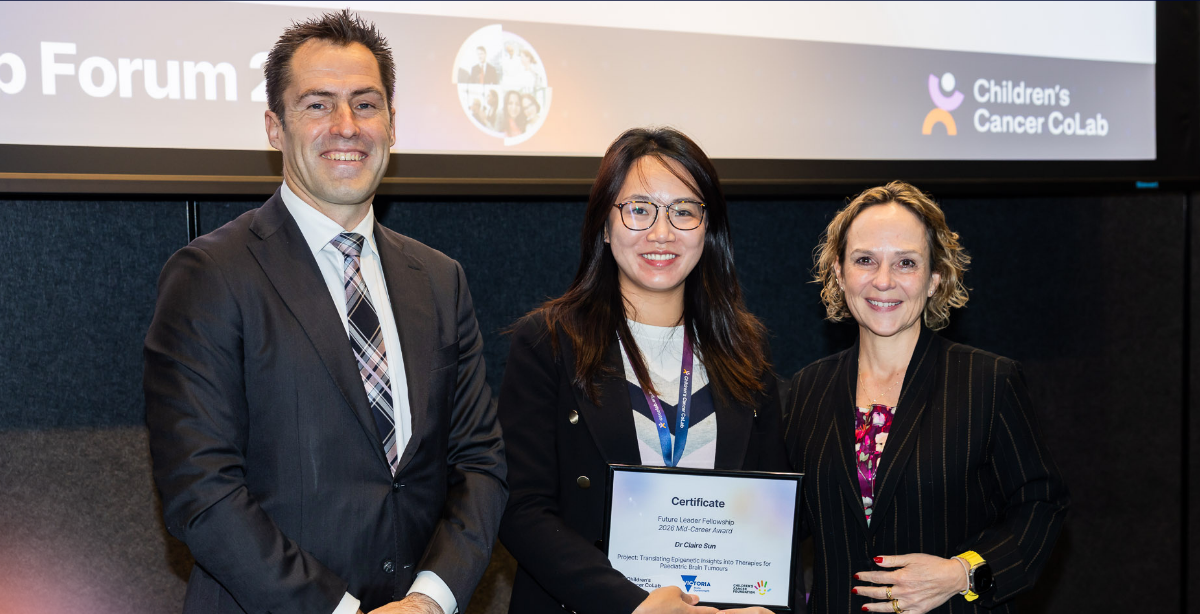
Dr Claire Sun from Hudson Institute of Medical Research has been awarded a prestigious Children’s Cancer CoLab Mid-Career Researcher Future Leader Fellowship.
Totalling $619,926 over three years (July 2026 to June 2029), the funding will supercharge Dr Sun’s pioneering research using artificial intelligence (AI) and epigenetics to discover safer, targeted treatments for childhood brain tumours.
Paediatric brain cancers are the leading cause of disease-related death in Australian children. Because childhood tumours are biologically distinct from adult cancers, traditional treatments like adult DNA-targeted therapies rarely work, meaning that fewer than 15% of children with high-grade brain cancers survive beyond five years.
Dr Sun heads Hudson Institute’s Computational Therapeutic Discovery Group, working to change this paradigm by focusing on the epigenome – the layer of reversible chemical switches that control how genes are turned on and off.
“I am incredibly honoured to be named an inaugural Children’s Cancer CoLab Future Leaders Fellow,” said Dr Sun. “This funding is a vital boost that allows us to focus on targeting the dysregulated epigenome. By harnessing artificial intelligence to decode cancer complexity, we are turning massive amounts of biological data into real, personalised therapeutic opportunities for children who desperately need them.”
Mapping, Targeting, and Predicting with AI
The three-year project leverages the Childhood Cancer Model Atlas (CCMA) – the world’s largest open-source collection of over 400 high-risk paediatric cancer cell lines, a framework Dr Sun has driven since 2018. The fellowship will fund three primary pillars:
- Mapping the Epigenome: Generating the first comprehensive maps of chromatin states across major childhood brain cancers.
- Identifying Functional Targets: Using advanced CRISPR gene-editing to pinpoint the exact epigenetic regulators tumours rely on to grow, testing drug combinations to beat treatment resistance.
- Predicting Therapies with AI: Integrating multi-omics data to build AI models capable of predicting which patients will respond best to specific therapies.
The project will also culminate in a new clinician decision-support platform, CCMA-EPIC, designed to help oncologist interpret patient tumour profiles in real time.
Co-designed by families, built for impact
Reflecting a deep commitment to the patient community, Dr Sun’s research was co-designed alongside Hudson Institute’s Patient and Family Advisory Committee.
“This project is built on lived experience,” Dr Sun emphasised. “Our patient and family advisors identified ‘effective therapies with less toxicity’ as their absolute top priority.
This funding ensures they stay at the centre of our lab’s steering committee, directly shaping how we communicate findings and refine our goals to improve both survival and long-term quality of life.”
Findings from the project will be integrated into Australia’s ZERO Childhood Cancer Program and shared globally through partnerships like the Children’s Brain Tumour Network, ensuring international impact.
This research was supported by | Children’s Cancer CoLab Mid-Career Researcher Future Leader Fellowship - $619,926 over 3 years

In this article

About Hudson Institute
Hudson Institute’ s research programs deliver in three areas of medical need – inflammation, cancer, women’s and newborn health. More
Hudson News
Get the inside view on discoveries and patient stories
“Thank you Hudson Institute researchers. Your work brings such hope to all women with ovarian cancer knowing that potentially women in the future won't have to go through what we have!”