
Rare genetic discovery explains sex development differences in XY females
By Rob Clancy, staff writer. Reviewed by Shirin Moradi Fard

Two young girls in Vietnam are living proof that there is a lot more to sex than genetics, after being found to have an extremely rare sexual development condition.
Thanks to their doctors in Hanoi and researchers at Hudson Institute of Medical Research, they have been identified as XY females, and the exact source of their genetic difference has been identified for the first time.
Their findings are detailed in the Journal of Clinical Endocrinology & Metabolism, the leading journal for the study of differences of sexual development (DSD).
An incredibly detailed analysis of the siblings’ genetic makeup showed that a particular combination of variations from each parent gave them external female appearance and low testosterone levels despite having XY chromosomes.
Key Points
- Two siblings in Vietnam have both been found to have an extremely rare genetic condition
- They each have X and Y chromosomes but have low testosterone levels and display female physical characteristics
- Their condition is the result of receiving specific genetic variations from each of their parents
- One of these genetic changes was hidden deep within the gene, and laboratory experiments showed how it disrupted normal RNA processing
- They represent just the fourth confirmed case of this condition.
Detailed genetic testing confirms difference of sexual development
The analysis was conducted by PhD student Shirin Moradi Fard under the supervision of DSD specialist Professor Vincent Harley.
Working with clinician-researcher, Dr Uyen Le, they studied the children’s genomes to a level of detail that has rarely been attempted previously, resulting in just the fourth confirmed case of this specific DSD worldwide.
“We describe the condition as compound heterozygote, the first example in this condition.” said Prof Harley. “That means a single genetic variation has been passed from each parent. These variations have no adverse effect individually, but when combined, they cause this DSD.”
Ms Moradi Fard says a mind-boggling level of genetic detail was examined to reach a confirmed diagnosis.
“Initial genetic tests looking at the coding regions of the patient DNA were inconclusive, so their doctors asked Dr Le and the team to consider genome sequencing,” she said.
“That means going from analysing around 3 million bases to analysing 3 billion bases.”
Looking beyond genetic coding
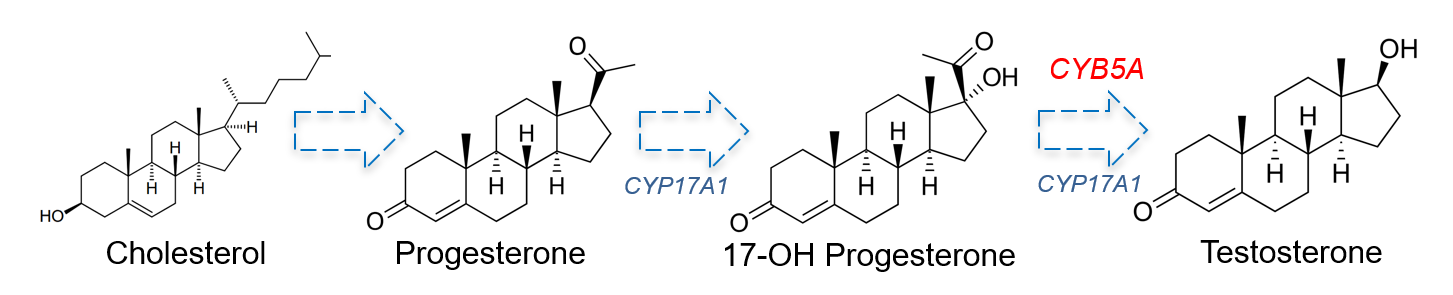
“We looked beyond the parts of DNA that code for proteins and found a change hidden deep within the CYB5A gene. I then tested this change in the lab and showed that it caused an extra piece to be added to the gene’s RNA message. This introduces an early stop signal, which is predicted to prevent the production of a working protein involved in making sex hormones.”
The family brought the children to see specialists in Hanoi over concerns the older child was not experiencing puberty, and initial genetic test failed to find a cause.
Prof Harley compares this study to searching for a needle in a haystack.
PhD student Moradi Fard’s in-house pipeline analysis was later replicated using a Swiss Artificial Intelligence (AI) system trained to identify genes associated with DSD, which confirmed its accuracy.
Dr Le then conveyed the findings to the clinicians in Vietnam.
“I told them we have very strong evidence to prove that this genetic variant is affecting the structure of proteins that are essential to sex development.”
The team believes the specifics of this DSD can be added to genetic screening during pregnancy for families in which it has previously been identified.
“This genetic condition is very specific to this family,” Dr Le said. “So, if they plan future pregnancies, especially through IVF, there can be a pre-natal diagnosis.”
What is intersex?
Intersex is an umbrella term for people whose reproductive organs, sexual anatomy or chromosome patterns differ from the biological definition of male or female. There are many ways someone can be intersex as it involves a spectrum of reproductive characteristics. Being intersex is a natural variation in humans, it does not mean there is something wrong.
Intersex traits can relate to
- Genitalia
- Internal anatomy
- Sex Hormones
- Chromosome combinations different to XY (male) and XX (female).
Some intersex people have both ovarian and testicular tissue, while others have atypical female or male genitalia, or male/female genitalia with variations in their internal organs and/or hormones. Some intersex conditions may be related to underlying concerns that might require medical care, but people who are intersex are generally as healthy as those who are not.
Collaborators | National Children’s Hospital in Vietnam
This research was supported by | NHMRC Ideas Grant 2002426
Journal | The Journal of Clinical Endocrinology & Metabolism
Title | Biallelic CYB5A disruptions in 46, XY DSD: Novel missense and deep intronic variants
View publication | https://doi.org/10.1210/clinem/dgag395

In this article


About Hudson Institute
Hudson Institute’ s research programs deliver in three areas of medical need – inflammation, cancer, women’s and newborn health. More
Hudson News
Get the inside view on discoveries and patient stories
“Thank you Hudson Institute researchers. Your work brings such hope to all women with ovarian cancer knowing that potentially women in the future won't have to go through what we have!”
