
News
Popular searches: Influenza, Childhood cancer, Endometriosis, Inflammation
-

More than 100 new gut bacteria discovered in human microbiome
Scientists working on the gut microbiome have discovered and isolated more than 100 completely new species of bacteria from healthy people’s intestines.… Read more
-

Collaborative grants awarded after speed-networking
Two grants of $10,000 each were awarded to Dr Jemma Evans and Dr Nicole Kellow (SCS; Nutrition, Dietetics and Food); and Dr Courtney McDonald and Dr Shu Wen Wen (SCS; Centre for Inflammatory Diseases). Organised by Hudson Institute and School of Clinical Sciences ECR committees, the initiative encourages early career researchers from across the MHTP… Read more
-

Prestigious grant for cardiovascular research
Dr Jun Yang has been awarded a prestigious $100,000 research grant from the Rebecca L Cooper Medical Research Foundation to find out more about how aldosterone might cause cardiovascular disease. Aldosterone is an important hormone in our body, but if produced in excess it can cause high blood pressure, stroke and heart attack. While it’s… Read more
-

Innovative clinical guide to help babies born with DSD
Boy or girl? Sometimes the answer is not straightforward.… Read more
-

Research uncovers clues to cause of endometriosis
Scientists are one step closer to understanding the cause of the debilitating condition endometriosis, following the completion of a study into cells found in the lining of the womb called the endometrium. In the study, published in the journal Human Reproduction, Professor Caroline Gargett and her team sought to determine whether regenerative cells called endometrial… Read more
-

Childhood Cancer Research Symposium: Cutting-edge science advancing childhood cancer treatment
More than 150 leading clinicians and scientists heard from national and international experts in childhood cancer at Hudson Institute of Medical Research on Wednesday, 13 February at a highly anticipated international symposium. The symposium was made possible through the generous support of our premium partner, the Children’s Cancer Foundation, along with the Isabella and Marcus… Read more
-

Natural mesh provides hope for pelvic organ prolapse
A safer and more effective treatment for women with pelvic organ prolapse (POP) may be on the horizon, thanks to a new technique that uses a woman’s own stem cells to boost the effectiveness of a degradable mesh. A study published in Biomacromolecules, led by Dr Shayanti Mukherjee, shows how a degradable mesh, made from… Read more
-

Almost 2000 unknown bacteria discovered in the human gut
Leading microbiome expert, Dr Sam Forster, in collaboration with researchers at EMBL’s European Bioinformatics Institute and the Wellcome Sanger Institute (UK) have identified almost 2000 bacterial species living in the human gut.… Read more
-

Review highlights dedication to improving reproductive health
As part of a series on influential women in reproductive health, Professor Lois Salamonsen, Australian Academy of Science Fellow and former Head of our Centre for Reproductive Health, was invited by the journal Reproduction to write a review – My Womban’s Life: Understanding Human Endometrial Function. For more than 35 years, Prof Salamonsen has dedicated… Read more
-
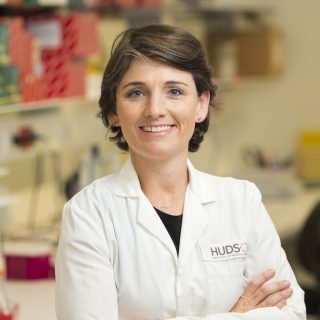
Top award for milestone paper
A landmark Nature study that sheds light on how E.coli wreaks havoc on the body has earned Hudson Institute researcher, Dr Jaclyn Pearson, one of the nation’s top scientific awards. The National Association of Research Fellows (NARF) awarded Dr Pearson the 2018 Postdoctoral Investigator Award for her research that shows how some types of E.coli… Read more
Hudson News
Get the inside view on discoveries and patient stories