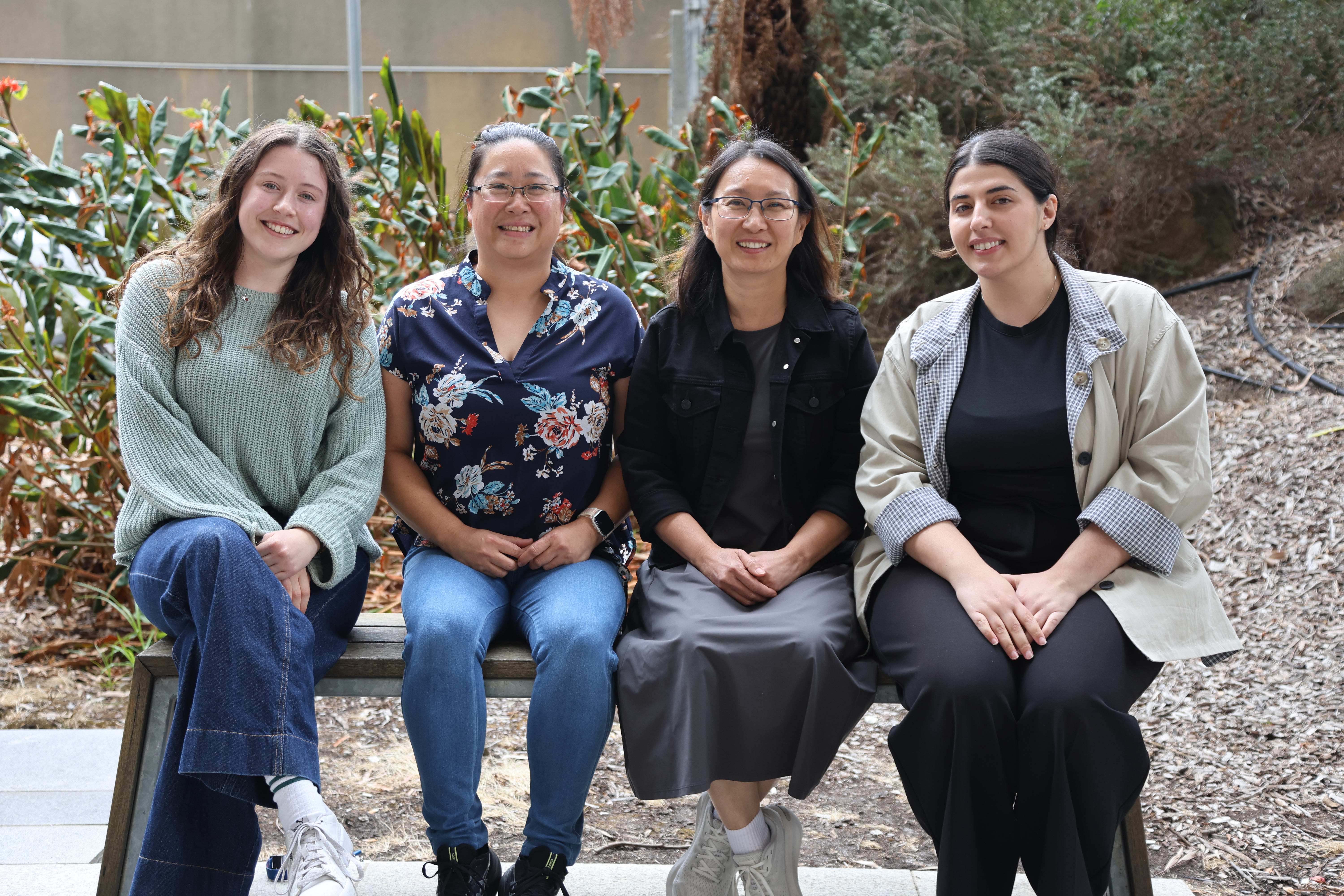
Dr Shanti Gurung is a Research Scientist at the Ritchie Centre, Hudson Institute of Medical Research, Adjunct Research Associate in Obstetrics and Gynaecology at Monash University, and, since 2026, a Postdoctoral Fellow at the Ainsworth Endometriosis Research Institute. She trained originally in medicine (MBBS, Manipal College of Medical Sciences, Nepal, 1998–2003) before moving into biomedical research, completing Bachelor of Medical Science/Honours and a PhD (2012–2017) at the Ritchie Centre under Professors Caroline Gargett and Jerome Werkmeister.
Dr Shanti Gurung and her research team
Her doctoral research showed that TGF-β receptor inhibition preserves the properties of endometrial mesenchymal stem cells (eMSCs) during culture expansion, work that generated a PCT patent application and underpins ongoing tissue-engineering approaches to pelvic organ prolapse.
From 2018 to 2020 she trained as a Postdoctoral Scientist under Professor Lois Salamonsen at the Centre for Reproductive Health, Hudson Institute, studying how extracellular vesicles and the soluble secretome of hormone-primed endometrial epithelial and decidualised stromal cells direct embryo development and implantation using in vitro, ex vivo and a mouse model of implantation, work published in Molecular Human Reproduction and Proteomics.
Since 2020, her research has focused on endometriosis, investigating menstrual fluid extracellular vesicles, microbial dysbiosis and antimicrobial peptides in reproductive tract biofluids and tissues as tools for non-invasive diagnosis and a new avenue to understanding endometriosis and identifying therapies. Her 2025 first-author paper in the Journal of Extracellular Vesicles drew wide media coverage, including national newspaper and broadcast interviews.
Dr Gurung has secured over $1 million in competitive and philanthropic funding, including as chief investigator on grants from Endometriosis Australia, the CASS Foundation, Perpetual’s IMPACT Philanthropy (Endometriosis), and Fundación La Marató (Endometriosis, International Collaborative grant). She has supervised PhD, a Masters, and several Honours students, many of whom progressed to MD or PhD programs. She sits on the Hudson Institute’s Early Career Researchers committee and was an awardee of the Women’s Health Research Translation and Impact Network-Emerging Leaders Fellowship Program.
J.L. Balough, K. E. Schwab, T. M. Stransky, T. Chu, A. R. Cameron, S. P. Babu, S. Gurung, K. Rytel, C. E. Gargett, K. E. Orwig, P. A. Moalli. (2026) Epithelial stem cells in the premenopausal human vagina. Nature Communications (under Review).
S. J. Savin, K. L. Loveland and S. Gurung. (2026) The hidden impact of endocrine-disrupting chemicals on endometrial and reproductive health. (accepted for publication in Reproduction, Fertility and Development)
A. Sadiasa, J. A. Werkmeister, S. Gurung, C. E. Gargett. (2025) Steps towards the clinical application of endometrial and menstrual fluid mesenchymal stem cells for the treatment of gynecological disorders. Expert Opinion in Biological Therapy. Mar;25(3):285-307. doi: 10.1080/14712598.2025.2465826.
S. Gurung, J. Piskopos, J. Steele, R. Schittenhelm, A. Shah, F. L. Cousins, T. T. Tapmeier, C. E. Gargett. (2025) Potential Role of Menstrual Fluid‐Derived Small Extracellular Vesicle Proteins in Endometriosis Pathogenesis. Journal of Extracellular Vesicles. Mar;14(3):e70048. doi: 10.1002/jev2.70048.
A. Rai, Q. H. Poh, M. Fatmous, H. Fang, S. Gurung, B. Vollenhoven, L. A. Salamonsen, D. W. Greening. (2021) Proteomic profiling of human uterine extracellular vesicles reveal dynamic regulation of key players of embryo implantation and fertility during menstrual cycle. Proteomics. Jul;21(13-14):e2000211. doi: 10.1002/pmic.202000211.
S. Gurung, D. Greening, A. Rai, J. Evans, L. Salamonsen. (2021) The proteomes of endometrial stromal cell-derived extracellular vesicles following a decidualizing stimulus define the cells’ potential for decidualization success. Molecular Human Reproduction. Sep 29;27(10):gaab057. doi: 10.1093/molehr/gaab057.
R. Lucciola, P. Vrljicak, S. Gurung, C. Filby, S. Darzi, J. Muter, S. Ott, J. J. Brosens, C. E.Gargett. (2020) Impact of sustained Transforming Growth Factor-β receptor inhibition on chromatin accessibility and gene expression in cultured human endometrial MSC. Frontiers in Cell and Developmental Biology. Sep 1:8:567610. doi: 10.3389/fcell.2020.567610.
M. Bozorgmehr*, S. Gurung*, S. Darzi, S. Nikoo, S. Kazemnejad, A. H. Zarnani & C. E. Gargett. (2020) Endometrial and menstrual blood mesenchymal stem/stromal cells: biological properties and clinical application. Frontiers in Cell and Developmental Biology. Jul 9:8:497. doi: 10.3389/fcell.2020.00497. (* equal contribution)
S. Gurung, D. Greening, S. Catt, L. Salamonsen, J. Evans. (2020) Exosomes and soluble secretome from hormone-treated endometrial epithelial cells direct embryo implantation. Molecular Human Reproduction. Jul 1;26(7):510-520. doi: 10.1093/molehr/gaaa034.
S. Gurung, S. Williams, D. A. Deane, J. A. Werkmeister & C. E. Gargett. (2018) The transcriptome of human endometrial mesenchymal stem cells under TGFβ R inhibition reveals improved potential for cell-based therapies. Frontiers in Cell and Developmental Biology. Dec 4:6:164. doi: 10.3389/fcell.2018.00164.
S. Gurung, J. A. Deane, S. Darzi, J. A. Werkmeister, C. E. Gargett. (2018) In vivo survival of Human Endometrial Mesenchymal Stem Cells transplanted under the kidney capsule of Immunocompromised mice. Stem Cells and Development. Jan 1;27(1):35-43. doi: 10.1089/scd.2017.0177.